Case Study - Unlock Your Phone by Earning It
MuscleScreen gamifies screen time by requiring physical exercise to unlock distracting apps, turning idle scrolling into active living.
- Client
- MuscleScreen
- Year
- Service
- iOS development
Overview
The average person checks their phone over 150 times per day, much of it mindless scrolling through social media, short-form video, and news feeds. Screen time apps exist, but they rely on willpower alone: a simple "ignore limit" button undoes every good intention. MuscleScreen takes a fundamentally different approach.
Instead of shaming users or relying on self-discipline, MuscleScreen turns every phone unlock into a micro-workout. Want 10 minutes of Instagram? Do 20 squats first. The result is a system where distraction fuels fitness rather than destroying it.
The Problem
Screen addiction and sedentary lifestyles are two of the biggest health challenges of our generation, and they reinforce each other. People sit on the couch scrolling for hours, knowing they should move but unable to break the cycle. Existing solutions fall into two camps:
- Screen time limiters that are too easy to bypass
- Fitness apps that rely on intrinsic motivation, which fades quickly
Neither addresses the root cause: the phone itself is more rewarding than exercise. MuscleScreen flips that equation by making the phone reward contingent on physical effort.
What We Built
Technologies: Swift • SwiftUI • Apple Vision Framework • FamilyControls API • SwiftData • AVFoundation
MuscleScreen is a native iOS app built with a multi-target architecture required by Apple's Screen Time API. The system consists of three coordinated components:
- The main app: handles onboarding, the dashboard, exercise challenges, and settings
- DeviceActivityMonitor extension: a background process that fires when a blocked app is launched
- ShieldConfiguration extension: renders the interception UI that replaces the blocked app
Camera-Based Exercise Verification
Using Apple's Vision framework and VNDetectHumanBodyPoseRequest, MuscleScreen detects body poses in real time through the front camera. The system tracks joint angles to count reps for squats, push-ups, and other exercises, no wearable required.
The Living Avatar System
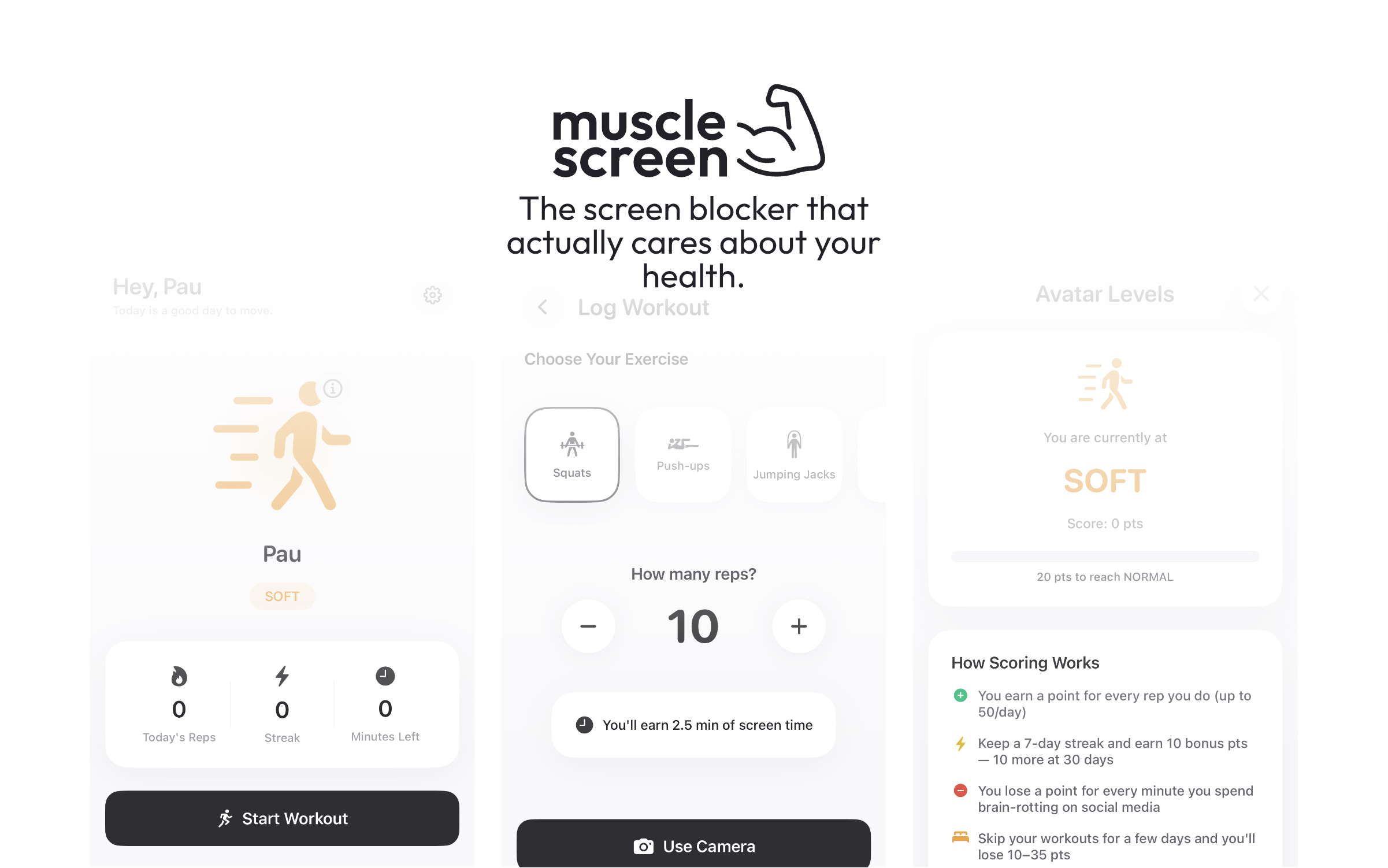
At the heart of MuscleScreen is an emotional retention mechanic: a cartoon avatar that reflects the user's fitness behavior. Users choose between three characters (Bicep, Glute, or Abs) each with six visual states ranging from Beast Mode to Critical condition.
The avatar strengthens with consistent exercise and deteriorates with inactivity. Users earn points for reps (+1 per rep, capped at 50/day), streaks (+10 at 7 days, +20 at 30 days), and lose points for excessive screen time (-1 per minute) and inactivity (up to -35 for 3+ days idle). This scoring maps to the avatar's visual state, creating a Tamagotchi-like bond that drives daily engagement.
Smart Scoring Engine
The points engine is a pure, testable algorithm that balances multiple inputs (reps completed, screen time consumed, streak length, and days since last activity) into a single avatar state. This keeps the feedback loop tight and understandable: exercise more, scroll less, watch your character thrive.
Key Technical Highlights:
- Real-time pose detection using Apple Vision framework
- App Group shared containers for cross-process communication between the main app and extensions
- Local-first architecture with SwiftData, no backend required for V1
- Emergency override that preserves user autonomy but applies avatar health penalties
The Impact
MuscleScreen redefines the relationship between screen time and physical health. By embedding exercise into the most habitual behavior of modern life (picking up a phone) it removes the need for separate motivation. The avatar system creates genuine emotional stakes, and the camera-based verification keeps users honest without requiring additional hardware.
The app demonstrates that health and technology don't have to be adversaries. With the right design, the very device that fuels sedentary behavior can become the catalyst for an active lifestyle.
Visit musclescreen.com to learn more.